
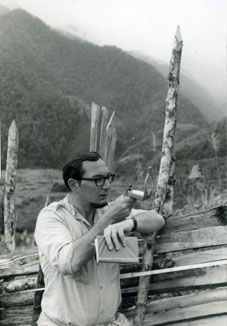
Godelier begins to survey a garden.
a. Agriculture and social organization [Back to top]
4. Studying external influences
Godelier begins to survey a garden.
To the ethnographer, a knowledge of the agricultural system grows hand in hand with knowledge of the social system. It would be as impossible to describe, let alone understand, the Baruya agricultural system without a knowledge of people's kinship and social relations, as it would be to understand Baruya social organization without being able to recognize their various crops and garden types. The clan identity of the people working in gardens has to be ascertained before the pattern of land use and ownership can be described. Conversely, a study of interaction in gardening matters provides information about social and political matters.
Godelier had worked out a questionnaire which he filled in for each garden he mapped. It started with specifying the ownership of the garden, and went on to reconstruct a list of all the people who had participated in clearing the forest and fencing the garden. Functionally, the fences are necessary to protect gardens from wandering pigs, which would eat easily available garden crops rather than search for food in the forest.
By paying attention to the fencing practices, Godelier learned which men helped which with this heavy task. He also learned how the men saved labor and material by re-utilizing fence posts from old, abandoned gardens when making new ones. In order to keep track of this practice, he painted numbers on certain fence posts, so he could trace their transfer from garden to garden. The fences actually served as "memory markers", reminding all concerned of who had contributed to the fencing of a garden.
Using his garden questionnaire, Godelier gathered past as well as present information, including the names and clan affiliation of each of the women who had plots in the garden. He found that women preferred to garden near friends with whom they could share conversation. He also discovered that they preferred to garden next to plots which were well weeded, so weeds would not easily spread among their own crops. Godelier's gardening record led to a map of social relationships among women. It graphically showed who was most friendly with whom, who trusted who, and who had obligations to whom.
b. Fallow cycle and soil types [Back to top]
The historical and social portions of the garden questionnaire were followed by questions more strictly agricultural in nature. Godelier estimated the length of the fallow cycle by extrapolating from answers given by the informants as to the length of time the area had been under second-growth forest before being cleared to make the garden. He checked this estimate by identifying the kind and size of each stump, taking into consideration the different rates of growth of each variety of tree.
The estimate of fallow time was complemented by an observation of the soil types. In planting their various crops, the Baruya pay close attention to small differences in environment: slope, altitude, and, especially, the quality of soil. The Baruya distinguish twenty different kinds of soil in terms of color and texture. Nine soil types are used for agriculture alone; the rest are used for cosmetic, healing, and ritual purposes. The best agricultural soil, called anyata, is loose and black. Next preferred is the red soil called itcheaka.
c. The mapping team [Back to top]
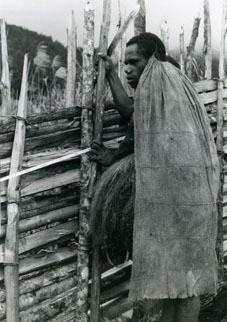
Gwadamaiwe helps measure the garden periphery.
Only after collecting all this information did Godelier proceed with the technical job of mapping. A team of young married men volunteered to help him with the job. They carried and set up the plane table, carried the surveyor's cross, and handled the tape, while Godelier used the compass and quadrant, recording the numbers and drafting individual maps of each garden. The young men distinguished themselves by their patience, endurance, and good humor over the long term task, even though, by the time they had completed the maps for several dozen gardens, the task had become very boring to all concerned.
d. Mapping the Tultul's garden [Back to top]
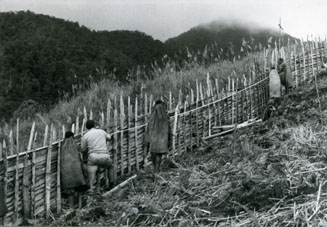
The edge of Tultul's garden.
Godelier had already mapped 158 gardens by the time the film team arrived and he got around to mapping the Tultul's garden. Since he had mapped gardens at many stages of their growing cycle, wherever possible he and his team had gone around the outside perimeter of the fences in order to avoid damaging crops.
Tultul's garden was at an earlier stage than the gardens he had previously mapped. It had only been cleared and fenced, but not yet planted. Godelier therefore concluded that it would be the perfect garden to use for filming the mapping procedure, since both the mapping team and the film team could move freely inside the garden without fear of damaging any seedlings.
[See Film Events 22 and 26, and Shots 46-72 in TO FIND THE BARUYA STORY.]
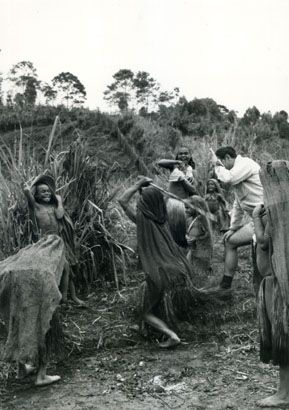
Halfway through the process, an argument developed between the men in the garden and women down below in the village. Since lively argument and invective are a normal part of Baruya daily life, Godelier continued mapping, totally unaware that the argument was caused by more than passing pique. None of the men present explained to him what was going on: the older men did not have an easy command of Pidgin English, and one of them felt the argument should not even be shared with Godelier. Koumaineu, his interpreter for all the years that followed, was working for Godelier for the very first time that day, and had not yet gotten used to the intricacies of the job. Moreover, since he was a young, unmarried man, Koumaineu himself only partly understood the argument. Godelier therefore encouraged the men around him to concentrate on the mapping work and to ignore the women.
Given the information available at the time, Godelier concluded that the argument had arisen because the women below felt left out, since, unlike the mapping team, they were not receiving any pay from him that day. Consequently, this was the way we accounted for the incident in the Film Event description. It was only thirteen years later, in 1982, while looking at the film in Paris with Koumaineu, that Koumaineu was able to give us all a new and more accurate interpretation of the event.
Koumaineu told us that the women had been concerned about the group of people who were all inside the new garden. Should any of these people have had sexual relationships the night before, the future fertility of the garden would be endangered. Sexual activity, according to the Baruya, releases dangerous spiritual forces. It must be segregated in time and space from gardens at all stages of production, including the stage just before planting. The women were concerned that the film team, in their ignorance, had broken the taboo. They also suspected that some of the young Baruya couples, who, though aware of the taboo, were beginning to dispense with traditional behavior, might also have broken it. This concern, and not pique, as previously thought, was the actual reason for their insistence that everyone just leave the garden.
If it were not for the film record, the explanation of this event would have remained unchanged and Godelier would not have learned that cleared garden earth was as susceptible to sexual pollution as were seedlings and more mature plants.
Godelier visits the moundeanga.
Because most of the Baruya trusted Godelier, and because he was not one of them, they accepted his occasional departures from their traditional behavior. For example, he gradually built up a relationship with the women that was most exceptional by Baruya standards. Beginning with his first year of fieldwork when he was aided by the presence of his wife and children, he talked to women more directly than any Baruya man would, given the men's strongly inculcated fear of female sexuality. His house, although a location for telling traditional men's stories, was nevertheless open to women. From the beginning his wife and daughter freely visited the exclusively female area of the village, the moundeanga, the location of the menstrual and birth huts. Eventually, one of the older women brought Godelier himself to visit this area.
He treated this special dispensation with care, and only visited occasionally, when women with whom he was already on especially good terms in the village were staying in the moundeanga. Such was the occasion of Ymbaingac's first menstrual period. Godelier took Allison Jablonko, the female member of the film team, to visit and film in the moundeanga at that time.
[See Film Events 27 and 40, and Shots 74-82 in TO FIND THE BARUYA STORY.]
It was only because Godelier had shown persistent interest for months that, in March 1969, the women came to trust him enough to invite him to the initiation ceremony held for Ymbaingac. They had earlier feared that he would talk about their rituals in front of Baruya men, thus exposing the secrets of women. They had, however, come to trust him after his repeated pledges of discretion, concretely exemplified by the fact that he wrote his notes about women's subjects in different notebooks than he used for the men's subjects.
His attendance at the women's initiation ceremony put him in an anomalous position vis-a-vis the men. They felt that he could not simply return to the village because of the danger that he would bring with him the contamination of female sexuality. The men, therefore, improvised a ritual by adapting the traditional ritual used by women when returning home after menstruating. The men performed this adapted ritual, decontaminating Godelier after he had created this unprecedented situation.
Since this decontamination ritual took place publicly in the village near Godelier's house, it is shown in the film. [See Film Event 37 and Shots 83-89 in TO FIND THE BARUYA STORY]. The women's initiation ceremony itself was not included in the film precisely to honor the trust that the women had shown to Godelier and Allison Jablonko. Had the initiation been included, the film could not be publicly screened in Papua New Guinea.[See Film Event 37, and Shots 83-89 in TO FIND THE BARUYA STORY.]
3. The kinship interview [Back to top]
Koumaineu in Godelier's house. Serving lunch for a group of informants.
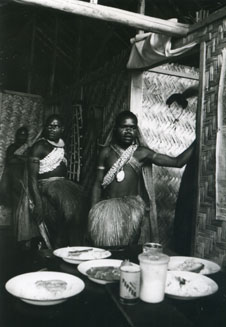
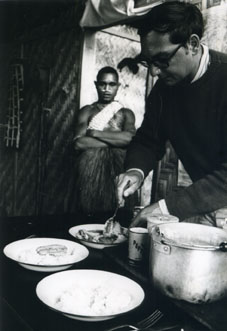
A kinship interview was, therefore, one of the subjects included in the original research film outline. Godelier planned to invite the following people: Warineu, one of his most faithful, all-round informants; Djirinac, a woman with an incredible memory for names and genealogies; and, for contrast, the Tultul, who had shown no previous interest at all in genealogical work. Gwataie would be the interpreter.
On March 22 the interview was planned for the next day. But on the morning of March 23, a piglet-barkcloth exchange unexpectedly occurred, and we had to film that. Warineu, therefore, went off to his reed garden to repair recent storm damage. When the film team finally returned to Godelier's house, Warineu was called, and he eventually came. By that time, Kandavatche, a salt specialist and one of Godelier's regular informants, had turned up and Godelier asked him to join in, as well.
We filmed in Godelier's office, since this was the usual place where he worked with his informants. The office was smaller than the living room, and it was difficult to get a good camera position. So that all the people present could be seen in the frame together, the usual seating arrangements had to be changed: all the informants sat together on Godelier's left, instead of being more evenly distributed around the table. Gwataie, as usual, sat on Godelier's right.
At the beginning Godelier asked the informants to talk about things that they had already discussed, rather than going ahead from where they had previously left off. He explained that this was necessary so that people watching the film in the future would get an introduction to basic matters such as marriage patterns. The informants willingly cooperated in this plan. Even so, toward the end of the 2 hours and 14 minutes, new information surfaced, and Godelier learned about the shift in residential pattern that had taken place after the arrival of the Australian administration. [See Film Event 30, and Shots 11-55 in HER NAME CAME ON ARROWS.]
4. Studying external influences [Back to top]
In reconstructing Baruya history to the best of his ability, Godelier was helping to establish a baseline from which a study of the effects of Western influences on their society could proceed. Concurrently, he studied life at the patrol post and mission station of Wonenara both in order to obtain a fuller understanding of the Baruya situation of that period and in order to clarify the differences in intent and style between anthropological work, mission work, and administration work. He commented in a conversation in 1982,
"The job of an anthropologist is not to change a society, but to understand it."
a. The patrol post [Back to top]
Due to the gradual spread of Western influences through New Guinea, groups of people in different areas have often been at various stages of transition between traditional ways and modern ways. By the time the first patrol post in Wonenara was opened in 1960, and was manned by a white Australian officer with the help of a native clerk and native policemen, some coastal peoples had already been Christians for two to three generations, and many were literate. It was these people who became the clerks and policemen and took part in the effort to pacify highland areas and to introduce Western ways to highland peoples. Notwithstanding this effort, intermittent fighting among the different Baruya groups continued for some time, although it was firmly discouraged by jail sentences handed down by the patrol officer, who confined local fighters to the prison that had been built as part of the patrol post.
For seven to eight years after the Australian administration had substituted its own power for the Baruya power to keep territorial boundaries inviolate, Baruya men still went to work in their gardens carrying bows and arrows in case of enemy attack. The high, protective fences built of vertical stakes that had previously surrounded villages were gradually replaced by heavy, low fences constructed of horizontally placed planks meant solely to keep the pigs out.
By 1965 an airstrip had been constructed in Wonenara. To build it, the administration had recruited all able-bodied men, who were paid a wage established by the Australian administration. The airstrip became the channel for continuous change: each week, weather permitting, two airplanes would come in from Goroka, one to bring the administration supplies, personnel, and mail, and the other to bring supplies to the mission.[See Film Event 50, and Shots 200-203 in TO FIND THE BARUYA STORY.]
b. The mission station [Back to top]
The Lutheran Mission, opened in 1965, served the Christian residents of Wonenara, in particular the native police force and school teachers, who, coming from more acculturated areas of New Guinea, were already Christian. In addition, the mission provided moral support for the native evangelists, who also came from different parts of New Guinea and who were introducing Christianity to the local people in villages near Wonenara. The missionary rotated Sunday services between Wonenara, where he held regular services for Christians, and the surrounding villages, where services for the as-yet-unconverted were held. These later services lacked communion and the sermons were simpler. [See Film Event 77, and Shots 213-230 in TO FIND THE BARUYA STORY.]
The missionary saw his role in the following light:
"The Baruya lived just as our own ancestors did 5,000 years ago. When the white people came ... the police, the anthropologist ... and the airstrip was built, the Baruya began to see new things and they began to feel new needs. The men went down to the coast and in 45 minutes came to a world that was 5,000 years different from their own. In order to be able to handle this culture contact, they are going to need to go through an inner change. And it is to facilitate this inner change that the mission devotes its work."As part of its work, the mission operated schools for the children of the patrol post personnel and any local children whose parents wished to send them. In contrast to traditional Baruya education, which took place both in the context of practical daily life and during the initiation ceremonies, the mission education was completely removed in both content and form from the Baruya model. The first schools, customarily called "Bible Schools", taught Pidgin English and prepared the children to do simple arithmetic and read the New Testament in Pidgin English.
[from conversation with Rev. Tuerschman after viewing the footage together in Basel, 1971]
The first generation of Baruya school boys attended this Bible School, until one day some men from Kainantu (a town about 50 km. north of Baruya territory) passed through Wonenara and asked them, "What kind of a school do you have?" Told it was a Bible School, the men from Kainantu responded, "Well, you'll become mission workers, that's all!" The boys had seen for themselves that mission workers were neither well paid nor did they have many possibilities of advancement, and so they said to each other, "What? Are we going to become mission workers?" And they ran away from school and left to work on plantations instead. This was an instance where information regarding new possibilities was circulated between regions and tribes and enabled individuals to make critical choices.
In 1969 the mission did not allow boys to come to school in their local clothing, but required them to wear shorts. This, of course, imposed a financial burden on the local families, the more so when school fees were introduced. Families came to look upon the education of their children as an investment, and they expected the children to complete a training that would allow them to return home and share the results of their training, either cash or skills, with the members of the family who had not left home.
In 1975 Papua New Guinea became an independent nation and, by 1980, a greater balance between tradition and western ways had been achieved: children could come to school wearing their tribal dress, and once a month they were indeed required to do so in celebration of "National Culture Day".
Another mission activity was the trade store for which the missionary himself put up $100 Australian and the local people put up another $100. According to the missionary, this store was worth $14,000 at the end of its first year of operation! The store served not only local people, but also the personnel of the mission station and patrol post: teachers, policemen, warders, and their wives. Local people began to purchase nails after they had seen how they could be used in house construction. Cigarettes were available in the store, but only police and mission personnel bought them, since the Baruya had limited cash and could smoke their local tobacco in bamboo pipes. Local people were, however, attracted to European clothing and food. Umbrellas were particularly useful in the rainy climate, and the canned meat and fish were an easy and tasty source of protein.[See Film Event 72, and Shots 204-211 in TO FIND THE BARUYA STORY.]
c. New economic possibilities [Back to top]
Quite apart from contact with the representatives of Western culture who were living right on their doorstep, some Baruya men had already traveled out of the valley and had had direct experience of ways of life other than their own. Since the early 1960's, young men had been recruited to go to work for two year stints at coastal plantations.
"They weren't forced in terms of anyone telling them 'you should go now', but they wanted the money and they wanted to look at the outside world. So there was an economic constraint: the need of the "good" goods of the mission store. It was an imported, created need." [personal communication MG]By law, not more than 38% of the male population could be absent from the villages at any one time. By 1969 40% of the male population had already gone out at one time or another and worked on plantations for two year periods. There were very few cases in which any man was taken against his will, for the simple reason that most men were eager to take advantage of the opportunity to earn cash, to learn Pidgin English, and to see more of the world.
Whenever a plantation needed workers, an announcement was sent to various patrol posts. Several days before a plane was scheduled to come and pick up any volunteers, the local officer in charge would sign on whoever cared to go. During the event filmed, the clerk of the Wonenara patrol post did the necessary clerical work, as the patrol officer himself was away. This clerk had worked with the Baruya since the patrol post had first been established, and they felt he was their friend. He weighed the volunteers so that the precise weight of the plane load could be calculated. This standard procedure was applied to all passengers and their luggage on the small planes that served outlying airstrips in New Guinea. When the men actually left, they dressed in shorts and shirt, leaving their Baruya clothing behind for their return.[See Film Event 70, and Shots 236-246 in TO FIND THE BARUYA STORY.]
This particular group of volunteers went to Popondetta to work on a rubber plantation. There, as on any other coastal plantation, they met people from many parts of New Guinea, and took part in types of work and work organization totally new to them. They were provided with food, shelter, and pocket money, and at the end of the two years they were flown back to Goroka where they were paid 58 pounds. (One pound at that time was equivalent to U.S. $2.20.)
Before being flown the final stretch home to Wonenara, they would take their money to the trade stores of Goroka and buy gifts. In those days of early contact, the gifts consisted mainly of machetes, beads, and blankets. Upon homecoming, they would distribute these gifts to friends and relatives, and, in the course of a few weeks, the small amount of cash they might have brought home would also be redistributed through the kinship network.
Thus, the new sources of wealth and experience were still integrated into the traditional system of egalitarian distribution and male domination. Women were not a part of the groups that went out to learn about the rest of the world by direct, personal observation. Women stayed home and did not share in these new adventures.
The opportunity to earn cash locally was being introduced in Wonenara in 1969. At that time the central government was developing a technical assistance program for rural areas. It had sent four looms to Wonenara and had taught several people to use Australian wool to weave rugs that could be flown out and sold in Goroka. This program included both men and women, who could work on the looms 5 days a week. They were paid $6 Australian for two weeks' work.[See Film Event 13, and Shots 232-235 in TO FIND THE BARUYA STORY.]
d. The trip to Goroka [Back to top]
Godelier had been observing that the respect in which older men were held in Baruya society was being eroded as the younger men gained direct experience of the outside world. The older men's knowledge of this new world was limited to what they heard from the young men returning from their stints as volunteer laborers. Godelier had often thought of taking several of the older men of Wiaveu to an urban center, so they could see for themselves the modern life of a Western town. After filming with the Jablonkos in Wonenara, he decided to put this idea into practice.The catalyst for his decision was the fact that the visit could be recorded on film.
He invited Warineu, the eldest man of the Delye clan, and Inamwe, the shaman, to visit Goroka with him. Gwataie, who had been there before and could act as interpreter between the older men and the townspeople, came along also. Godelier and the three Baruya stayed in Goroka, the administrative headquarters of the Eastern Highlands District, for four days. Godelier conceived of the event as a sort of "state visit" by representatives of the Baruya people. He hoped that this visit would contribute to the Baruya's pride in their own culture and that it would establish, in the minds of the other highland people who would see them, the Baruya culture as one of the many local cultures to be respected and, indeed, cherished during this time of massive culture change.
The three Baruya men wore their finest traditional ceremonial clothing. Neither Warineu nor Inamwe possessed shorts or shirts, and it would, in any case, have lessened the impact of their visit had they appeared, as it were, incognito. Their traditional clothing made them the center of attention wherever they went.
The curiosity of the townspeople was aroused not so much by the clothing per se, as by the fact that this clothing identified the men as "Kukakuka", the name by which the Baruya were known throughout the New Guinea highlands. The Kukakuka had a reputation for being such fierce warriors that even distant tribes greatly feared them. For most of the young townspeople, this was the first direct contact with members of a group about which they had heard so much.
The District Commissioner, Jim Sinclair, who had been the first white man to enter Baruya territory 18 years previously, welcomed the little group and escorted them on a tour of the downtown area. Godelier also took them on visits to the Teachers' College, the main stores, an automobile sales center, the fire station at the airport, and the Pig Husbandry Development Center. [See Film Events 81, 82, and 83, and Shots 248-279 in TO FIND THE BARUYA STORY.]
Filming the visit to Goroka concluded the five-week collaboration between the Jablonkos and Godelier in the field, and the Jablonkos left for Australia on their way back to Europe.
©1998 - 2002 Allison and Marek Jablonko