
1. New Guinea
New Guinea, the second largest island in the world, is located north of Australia and east of Java. Although New Guinea was first " discovered" by Europeans in the 16th century, colonization did not begin until the end of the 19th century. The extreme roughness of
the terrain limited initial European contact to coastal areas, where coconut and rubber plantations, connected by shipping routes, were established. The Europeans recruited men from the many coastal tribes as workers on the plantations, and began to convert local people to Christianity.

|
Ipmani Forest.
Politically, the process of contact with the Western world started under Dutch, German, English, and Australian colonial administrations. After World War I, the Australians took over the administration of the whole eastern half of the island. The Dutch continued to administer the western half until 1963, when it came under the administration of the United Nations for a brief period, before becoming a province of Indonesia, Irian Jaya. The eastern half, called Papua New Guinea, became independent of Australia in 1975. It is divided into 14 provinces (formerly called districts), each with its own headquarters from which the outlying portions of the province are administered.
In the early years of contact, the Europeans thought of the interior of New Guinea as impenetrable and inhabited only by scattered groups of hunter-gatherers. This image was radically altered in the 1930's when Australian gold prospectors penetrated the central mountains and found, to their surprise, wide valleys lying at altitudes above 3,500 feet. These valleys were populated by tribes numbering in the tens of thousands, living in settlements that had as many as 2,000 people who supported themselves with intensive agriculture. The total highland population was estimated at close to one million people. [Connolly and Anderson 1987]
Using air links, the Australian administration immediately set about to establish a network of government outposts to connect the various highland areas to each other and to the more developed coastal towns. After the administration had stopped the traditional warfare among enemy tribes in the highlands, missionaries and traders were allowed in. Anthropologists, also, lost no time in coming to study the various highland groups. A chain of towns grew up, among them Goroka, which became the administrative center of the Eastern Highlands District and served as a supply center for more distant outposts.
The discovery and settlement of the main highland valleys "leap-frogged" many mountainous areas. After World War II, the exploration of these areas began, and patrol officers undertook expeditions to find as yet "undiscovered" tribes.
2. A historical introduction to the Baruya [Back to top]
In 1951 Jim Sinclair, a young patrol officer, set out on an expedition with the goal of finding the people who produced the large bars of salt which were traded throughout the Eastern Highlands and all the way down to the coast. None of the tribes so far contacted by Europeans made these salt bars, but all spoke of the salt makers as living further away across the mountains. After several weeks of walking, Sinclair reached Baruya territory, and there he found the salt makers. He was the first white man the Baruya had ever seen.
Sinclair remained in the area for only a short time, but the Baruya were "placed on the map," and, in 1960, the Australian administration set up a patrol post on the edge of Baruya territory, at the place called Wonenara.
The Baruya, who, in 1980, numbered 2,591 people, are one of the Anga-speaking tribes whose total population is approximately 65,000. Baruya territory lies 100 km. south of Goroka, as the crow flies, and is on the northern edge of the Anga area, which stretches south into Papua, almost reaching the coast. To the north and west of Baruya land lie the territories of tribes, such as the Fore, whose cultures and languages are radically different from the Anga. In 1969 the Baruya could only be reached by airplane or by several days of walking.
Though the Baruya share the same culture and language with the immediately neighboring Anga tribes, each tribe is politically independent and lays claim to its own territory by right of past conquest. Previous to the Australian pacification, each tribe defended its territory by force of arms, extending it, when necessary, and if possible, by warfare. The Baruya inhabit a dozen villages and hamlets at altitudes varying from 1,600 to 2,000 meters in the Wonenara and Marawaka valleys. The surrounding peaks rise to 3,720 meters.
The Baruya did not always inhabit their present territory. Their oral history recounts that they originally lived far to the south near Menyamya. About 200 years ago, during an intertribal conflict, they fled to the Marawaka valley. There they lived as refugees among the Anjie and the Usarampia tribes. Through marriage alliances they gradually gained control of some territory, and eventually extended that territory by warfare. Then, early in the 20th century, they extended their territory still further, crossing the Kratke Mountains into the Wonenara valley and pushing the previous inhabitants further north. They established three villages in the Wonenara Valley — Wiaveu, Wapme, and Yani — where they continue to live.
The original rain forest was cleared in areas near the villages, and crops are now cultivated in well-fenced gardens. After a season
of cultivation which lasts from two to three years, the land is allowed to revert to forest and lies fallow for a period ranging from twelve to twenty years. Sweet potatoes form the largest part of the Baruya daily diet, while taro root is of major ceremonial importance. Other vital agricultural concerns are pig husbandry and the production of vegetal salt for ritual and trading purposes.
Until 1967 the richness of Baruya culture was known only to the Baruya themselves. An understanding of the interrelationships between economy, territory, social organization and religion was embedded in Baruya daily life and ceremonies, mirrored in their oral tradition, and passed on from person to person according to individual interest. Knowledge about Baruya culture began to be accessible to the outside world only after the arrival of missionaries in 1965 and the anthropologist, Maurice Godelier, who arrived two years later.
3. The Anthropologist: Maurice Godelier
|
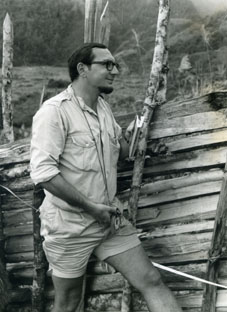
Godelier at work in a garden.
a. How Godelier chose to work among the Baruya
[Back to top]
When Maurice Godelier finished his anthropological studies in Paris in 1966, his professor, Claude Levi-Strauss, asked him to initiate a research project in New Guinea. Traveling from France to New Guinea via Great Britain, the United States and Australia, Godelier asked English, American, and Australian colleagues for information as to which area he might best work in. Upon arrival in New Guinea, he set off with a guide in one of the suggested areas to choose a research location first hand.
During his reconnaissance he met some missionaries who told him of people who were still living according to their own traditions. Following this clue, he eventually reached Baruya territory. He found that the Baruya had only recently ceased active warfare with neighboring tribes and were as yet little affected by European ways. They possessed a rich and complex agricultural system and engaged in an elaborate system of trade with neighboring tribes. Since Godelier's particular interest within anthropology was the comparison of economic systems, working with the Baruya offered him a particularly relevant opportunity for research.
An additional important factor influencing his choice was the location of Baruya territory. It was easily accessible by air, and there were villages located not more than 1-1/2 hours' walk from the airstrip. This would make it possible for his wife and two children to join him in the field, as well as to bring in the needed supplies easily. So, on the basis of both anthropological and personal considerations, he made the decision to do his fieldwork among the Baruya.
b. Godelier's house [Back to top]
Godelier arrived in Wonenara in June 1967. At that time, Wonenara was the location of the Australian Administration Patrol Post and of the only airstrip in Baruya territory. Godelier was welcomed by the local Australian Patrol Officer, the German Lutheran missionary, and an American linguist from the Summer Institute of Linguistics. For some weeks Godelier lived in Yani, a nearby village, in a little house belonging to the linguist. To pursue his work, however, Godelier needed to live in the midst of a traditional Baruya settlement, so, as soon as he got to know some local Baruya people, he broached the subject of building a house in Wiaveu, the village furthest from the patrol post.
The opinions of people in Wiaveu were divided. Some wanted a white man to live amongst them; others did not. Warineu, the oldest man of the Delye clan, was in favor. After much discussion with other Delye men and men of the Boulimambakia clan, it was decided that Godelier could rent a piece of Delye clan land bordering on Boulimambakia land and have a house built.

Godelier's house became a meeting place.
Godelier had given great thought to planning his house. It was to be a comfortable living area for himself and his family, as well as providing space for his work — well-lit surfaces for writing, and storage for equipment and books. In the house he envisioned, he would be able to offer hospitality to people in exchange for all the times they would receive him in their own homes or in the communal men's house. It was to be a unique area for working with the Baruya: as large, or larger than a Baruya men's house, it would, unlike a Baruya men's house, be open to women — not only to white women, but also to Baruya women.
He had noticed that the Baruya define space strictly according to the gender of the people allowed to use a given area. Each village is divided into three zones: a central zone where families live and men, women, and children move about freely; a high zone where the communal men's house is located, and only men are permitted; and a low zone where birth and menstruation huts are built and where only women may go. The Baruya transmit their everyday knowledge through conversations in the central zone, however ritual knowledge is transmitted only in the men's and women's zones, and at specific times, to ensure that the knowledge of initiates will never be heard by younger, uninitiated people, and that men's ritual knowledge will never be overheard by woman or vice-versa.
Godelier did not want to remain entirely dependent upon these Baruya restrictions on the times and locations of learning, and so he designed his house with a large closed-off workroom where people could work directly with him without fear that their teachings would inadvertently be overheard by others.
In exchange for money and the most sought-after goods, bush knives and steel axes, local men built Godelier's house according to his design. The house indeed functioned as he had planned. Not only did Godelier learn about Baruya culture through the many long discussions in this house, but the Baruya themselves were afforded a firsthand view of a segment of the European way of life.
c. The role of language [Back to top]
Baruya is a complex language which combines roots with prefixes and suffixes in order to create a rich variety of words with extremely precise meanings [Lloyd 1989]. For instance, a verb can appear without specifying either gender or number, or, by proper additions, it can present sixteen different combinations of gender, number, people, and animal. This gives the speaker a choice of making a statement which can range from being completely general to being precisely particular. For a foreigner to learn Baruya is a demanding and time-consuming project.
Godelier intended to learn Baruya during the first of his two years in the field and then continue his investigations without the use of interpreters. An unpredictable turn of events radically changed his plans: after only three months in the field, during a brief trip to Port Moresby to pick up his wife and children, he had an automobile accident which kept him in and out of the hospital for the next seven months. When he was able to return to Wiaveu, he was enthusiastically welcomed by the people who were eager to continue working with him. The end of his two year fieldwork period was already in sight, however, so his schedule did not allow any more time to be devoted to language study.
In order to gather information on the Baruya way of life, their world view, agriculture and trade, he therefore had to rely upon Tok Pisin (Pidgin English, as it was then called), the lingua franca of New Guinea, and upon the few local people who had learned Tok Pisin. These individuals worked with him, sometimes as informants, and sometimes as translators, working back and forth between Baruya and French via Tok Pisin.
Pidgin English had developed early in the century as a result of the interaction of missionaries, traders, patrol officers, and local people speaking many different languages. Its grammar has a Melanesian structure, while its rich vocabulary combines words from English, a number of New Guinea languages, and occasional German and Spanish words. It was given a written form and became the language of instruction in many mission schools, as well as the usual language of contact between local tribesmen and the native personnel of mission stations and patrol posts, all of whom had a variety of different mother tongues.
It was through contact with the outsiders at the Wonenara mission station and patrol post that some Baruya men and women learned Pidgin English. At the time of Godelier's arrival a handful of boys were attending elementary school at the mission, and it was one of these boys, Koumaineu, who eventually became Godelier's principal coworker.
d. Relationship with the local people [Back to top]
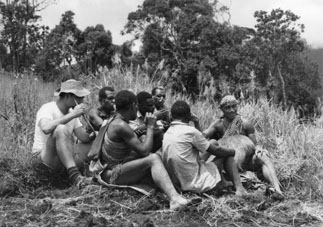
Godelier discusses land tenure with a group of men.
Godelier paid wages to the men and women who helped him either regularly or periodically with non-Baruya types of work, such as his own housework and cooking, the weighing of crops, or the mapping of gardens. He did not pay people for the information they shared with him or for the times when he was observing their own activities. He learned, however, to take into account traditional forms of sharing, and, whenever appropriate situations in family or ceremonial life occurred, he would contribute rice and canned meat and fish. During the course of each day Godelier shared European cigarettes and tobacco with local people who appreciated them as a change from their locally grown tobacco.
Godelier's first informant and translator, Gwataie, was a married man who had learned some Pidgin English working with the American linguist in Yani. They started working together while Godelier was still at Yani. It was Gwataie who introduced Godelier to Warineu, his father-in-law and the oldest man of the Delye clan. It was Warineu, in turn, who first took Godelier under his protection, whereupon Godelier was placed by the Baruya within their own lineage system: he was treated by everyone as if he, too, were a member of the Delye clan. This was indicated by their use of the appropriate kinship forms of address, such as father, brother, son, etc.
Godelier soon became friends with the members of Warineu's large family - his son, Pandjaouie, his daughters, son-in-law, and daughters-in-law, all of whom helped him in his early days of fieldwork. Warineu's family, though taking primary responsibility for Godelier's well-being, was not the only family interested in working with him.
From the beginning people of Wiaveu were solicitous of Godelier's welfare. He was accompanied by young people vying for each other to carry his camera, shoulder-bag, and umbrella. Occasionally they would help him negotiate a particularly difficult stretch of pathway, since, like most Europeans, he was unaccustomed to their physical environment.
Little by little his contacts expanded, not only in the village of Wiaveu, but in the neighboring villages of Yani and Wapme as well, and, eventually, through the clan ties of his local friends, right over the mountains to Marawaka.
He found that some people were more interested in working with him than others. Some individuals were never interested in having any contact with him, while others developed a permanent relationship with him. This was particularly so of Koumaineu, who had gone to a mission school as a boy and then left the area to work on plantations. In 1969, aged 17, he returned to Wiaveu, where his father, Kandavatché, was the salt-specialist. Almost immediately he began working as a translator for Godelier. He helped Godelier to complete all the investigations started with Gwataie's help, and then helped expand the inquiries, especially into the sphere of ritual knowledge. Their relationship grew so strong that Koumaineu continued to be Godelier's interpreter on all his subsequent trips to New Guinea.
Baruya people are outspoken and their interactions are forthright. Any question that arises, or any plan of action to be taken, is openly discussed by all concerned until a general consensus is reached. Picking up on this style of interaction, Godelier would introduce the idea of a project he would like to do, or an activity he would like to see, and, over a period of time, he would present the idea repeatedly, thus generating interest and excitement until enough people were in favor to actually put the idea into effect. The Baruya seemed to feel comfortable with this style of taking initiative — those who wanted to go along with Godelier did so with enthusiasm, while the others calmly went on about their own affairs. While viewing the films in Paris in 1981, Koumaineu commented of Godelier: "He was very good at putting people in a good mood, then working hard with them, and later paying them well."
The ability of the people to give so much of their time to Godelier's pursuits raises the question of why they had so much free time. The reasons, which became clear to Godelier in the course of his fieldwork, stemmed from two major factors. The first was the ending of hostilities and the imposition of peace by the Australian administration. Warfare had been time-consuming, but it had also been the source of a great deal of excitement and prestige. Interacting with white men and learning about new ways of life became a new type of exciting and prestigious activity. The second factor had to do with the fact that the major activity of the Baruya — agriculture — does not require constant, day-long labor. The Baruya did not work with fixed schedules, so they were free to rearrange their own activities as they themselves saw fit in order to participate as they chose in Godelier's work.
[Back to top]
©1998 - 2002 Allison and Marek Jablonko
©2002 - 2011 Allison Jablonko